The Reach of the MRI Magnetic Field
The MRI magnetic field is a living, breathing, reactive force that is often misunderstood and underestimated in its strength. This invisible force allows us to see inside the human body without ionizing radiation or invasive exploratory surgery. But it must be respected to minimize the risk of MRI safety accidents.
In this article, we’ll explore just how powerful MRI magnets are and how far their invisible reach extends beyond the scanner.
The Basics of the MRI Magnetic Field
At its core, an MRI machine is an electromagnet — the same principle as the nail-and-battery experiment from grade school.
But instead of picking up staples, these magnets produce powerful, uniform fields that allow high-resolution imaging of the human body.
One key difference is MRI magnets are supercooled in a liquid helium bath. They operate at ultra-low temperatures only 3 or 4 degrees above absolute zero, which is about -269 degrees Celsius.
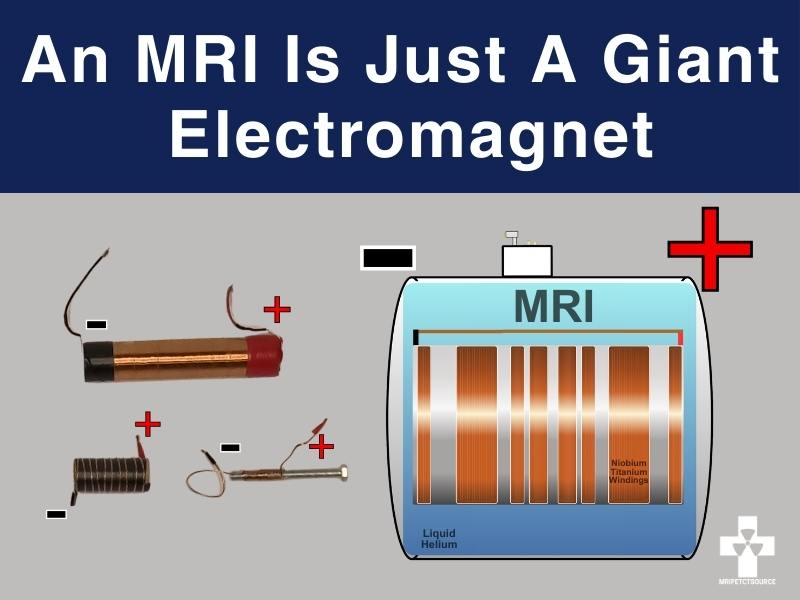
Instead of copper wire, the MRI magnet main coil windings are made of Niobium Titanium filament embedded in a copper matrix.
Why do MRI magnets use Niobium Titanium instead of Copper?
First, cooling copper to liquid helium temperatures (4 Kelvin) cuts its resistance by hundreds of times, but it never quite reaches zero resistance.
Second, the main MRI magnetic fields coils require between 5,000 and 8,000 windings at more than 700 amps to create a uniform magnetic field. That comes out to almost 20 kilometers of wire. The heat loss created by copper would be massive, in the kilowatts range.

Click here to receive a free Amazon Prime 30 Day Trial!
Full disclosure: As an Amazon Associate, I earn from qualifying purchases.
Superconducting Coils and Why They Matter
At liquid helium temperatures (about 4 Kelvin), niobium-titanium filaments become superconductive — carrying current with zero resistance. This allows a persistent current to maintain the strong magnetic field indefinitely.
The copper matrix provides:
- Mechanical Stability
- Quench Protection
At liquid helium temperatures, the embedded Niobium titanium filaments carry the current with zero resistance while the copper provides mechanical support and a safe path to divert current if a quench happens..

In the event of an MRI quench, the copper gives the quench protection system (heaters, dump resistors, etc.) time to activate and safely dissipate the stored magnetic energy.
How Far the MRI Magnetic Field Extends
The MRI magnet windings generate immense magnetic fields that naturally dissipate following the 1/r³ law. In practice, MRI magnets are passively or actively shielded which can reduce fringe magnetic fields by 45% to 65%.
- An unshielded 1.5T MRI extends about 15 meters (≈40 feet) along its central axis.
- An unshielded 3T MRI can extend up to 21 meters (≈70 feet) before blending into Earth’s magnetic field.
The 5-Gauss Line in MRI
The “reach” of an MRI is usually measured to the 5-gauss threshold, which is the safe limit for non-MRI personnel and standard equipment.
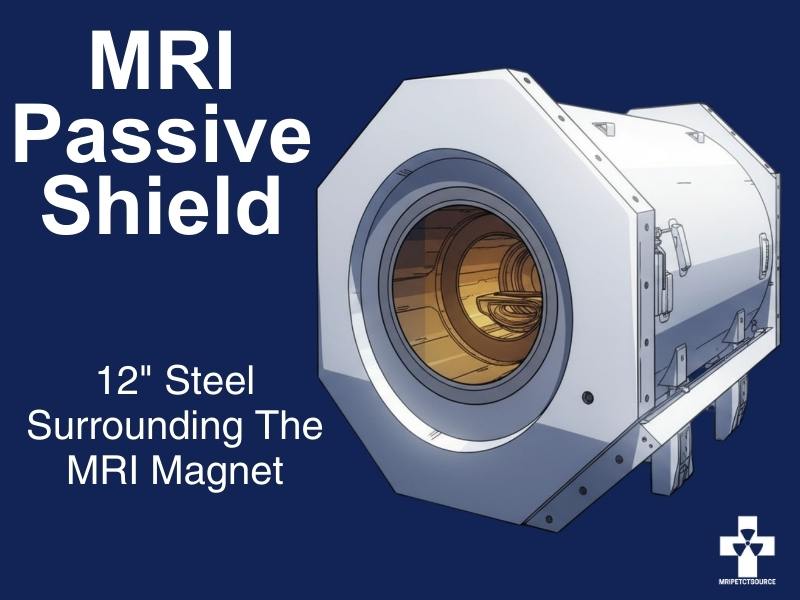
Since hospitals and imaging centers are full of patients, staff, and sensitive electronics, newer magnets are actively shielded or enclosed with ferromagnetic material to redirect and minimize the fringe field.
Keep your online privacy safe from third-parties with this special offer! IP masking and military-grade data encryption, while maintaining ultra-fast download speeds. I use Nord 24 hours a day to keep me protected and it’s definitely my preferred choice for a reliable VPN. Full disclosure: As an affiliate, I earn a commission when you purchase through this link.
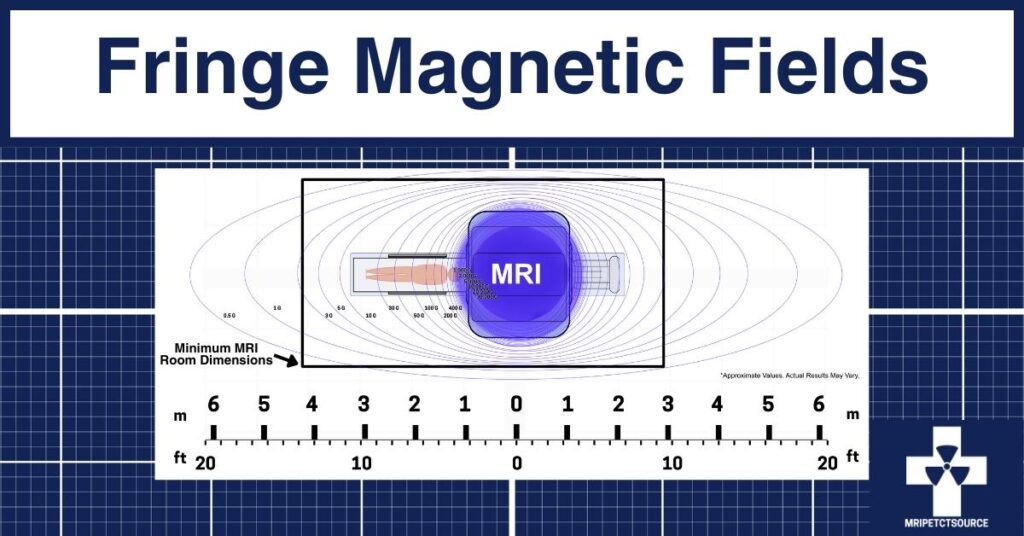
Fringe Magnetic Fields
So how far does a 3T MRI extend in practice?
- ~6 meters from the front and back of the magnet bore
- ~3.5 meters from each side, top, and bottom

This means the magnetic field of an average 3T MRI encompasses a space roughly 14m long × 9m wide × 9m tall, with the magnet at the center.
In practice, the magnetic field varies depending on environmental factors and can extend beyond the MRI suite walls, especially around the bore ends where the field is concentrated.
Real World Reports of Interference
The risks of fringe magnetic fields aren’t just theoretical, they are well know and documented.
In 1993, the Defense Tactical Information Center released a 57-page report after multiple helicopters reported interference with onboard magnetic sensors (compasses, gyroscopes).
In 2006, the FAA issued Safety Alert SAFO No. 06-007 after EMS pilots reported serious deviations in helicopter navigation systems when flying near hospital helipads with nearby MRI systems.
While these fields are usually less than 10 gauss on helipads, they are strong enough to disrupt sensitive electronics, including pacemakers and neurostimulators.
Key Takeaways
The MRI magnetic field extends much farther than most people realize. Even when shielded, fringe magnetic fields can affect sensitive electronics well outside the scanner room.

This is why MRI facilities strictly control access, enforce the 5-gauss line, and carefully manage installation near helipads, equipment, and patients with implants. Respecting the invisible reach of MRI is essential to keeping both patients and staff safe.
Related Resources
Quick Navigation Links
MRI Scan Patient Resources
Published:
Last updated:
This content is regularly reviewed and updated to provide accurate, helpful information across our website. We strive to ensure that all resources and articles are current and reliable for readers and professionals alike.

Author:
Author Bio:
Read more on Larry’s author page.
The information provided by MRIPETCTSOURCE (“we,” “us,” or “our”) on https://www.medicalimagingsource.com (the “Site”) is for general informational purposes only. All information on the Site is provided in good faith, however we make no representation or warranty of any kind, express or implied, regarding the accuracy, adequacy, validity, reliability, availability, or completeness of any information on the Site. UNDER NO CIRCUMSTANCE SHALL WE HAVE ANY LIABILITY TO YOU FOR ANY LOSS OR DAMAGE OF ANY KIND INCURRED AS A RESULT OF THE USE OF THE SITE OR RELIANCE ON ANY INFORMATION PROVIDED ON THE SITE. YOUR USE OF THE SITE AND YOUR RELIANCE ON ANY INFORMATION ON THE SITE IS SOLELY AT YOUR OWN RISK.
Amazon and the Amazon logo are trademarks of Amazon.com, Inc. or its affiliates.